

When a private equity firm closes on a platform company, IT is frequently treated as an administrative post-close detail. That’s the assumption that quietly caps the platform’s growth rate.
The absence of a unified IT blueprint isn’t a technology gap — it’s a business constraint. It shows up as slower integration timelines on every bolt-on, unplanned costs that erode EBITDA in the first 100 days, security exposure that gets priced into the next valuation, and operating partners who can’t get a clean view across the portfolio. Every one of those problems traces back to the same root cause: no common standard for how technology gets built, secured, and scaled across the platform. Without scalable IT infrastructure, the platform is forced to solve the same operational problems every time the business grows.
A sophisticated managed IT model isn’t about keeping the lights on. It’s the mechanism that converts IT from a recurring source of risk and cost into a repeatable, predictable input, one operating partners can plan around the same way they plan around working capital or headcount.
The Carve-Out Illusion: Where the Constraint Begins
On paper, a new platform investment can look clean. The diligence checklist notes an adequate internal IT team, a stable network, and functional day-to-day support.
The reality tends to hit during transition. Sellers frequently retain core infrastructure, software licenses, or security assets, forcing the newly independent company into a rushed migration under a tight Transition Services Agreement. A team sized to run a standalone mid-market business is suddenly asked to execute an enterprise-grade cutover while keeping daily operations running.
This is where the constraint takes hold. A diligence box marked "covered" that ignores this operational reality turns the first 90 days into reactive firefighting instead of the strategic foundation-setting that every later acquisition depends on. Every dollar and week spent stabilizing a shaky carve-out is a dollar and week not spent closing the next deal.
Building Your Platform's IT Foundation?
Get the step-by-step playbook for scaling IT after the deal closes.
Why Every Bolt-On Re-Solves the Same Problem
Platform companies are built to absorb compounding growth: new locations, bolt-on acquisitions, centralized reporting. Without a unified blueprint, every new company arrives with its own vendors, hardware, and access rules, adding chaos to the last acquisition’s tech stack, bolted onto the one before it. What should be a repeatable integration playbook instead gets priced and scheduled from scratch, every single time.
The direct cost of the missing blueprint is integration speed that gets slower, with each acquisition — the opposite of the operating leverage a platform strategy is supposed to generate. A unified standard reverses it, converting IT from a variable that resets with every deal into a fixed, predictable line in the M&A playbook.
.jpg?width=636&height=487&name=Image%20(14).jpg)
Replacing CapEx Surprises with Predictable OpEx
For operating partners and CFOs tracking value creation against a strict 100-day plan, IT shouldn't be a source of unpredictable capital expense.
A mature managed IT model shifts the financial paradigm. By tying support, infrastructure, and security costs directly to predictable metrics like headcount, active users, or location count, IT spend scales with company growth.
That predictability extends into the deal model itself. When the cost of onboarding 50 endpoints or securing a new facility is known before the LOI is signed, integration costs get underwritten with precision instead of estimated after close. That’s basis points of EBITDA that don’t quietly disappear into "surprise spend" in month one. This is where scalable IT infrastructure becomes more than an IT priority. It becomes a financial planning advantage.
Fragmented IT Means Fragmented Value
Most mid-market platforms run as a loose confederation of independent IT environments: each operating company carrying its own standards, its own patch cadence, its own read on compliance. The business consequence: the platform’s risk profile is set by its weakest acquisition, not its strongest, which shows up in cyber insurance premiums, in diligence findings on the next deal, and eventually in exit due diligence, where buyers price the platform on its most exposed entity.
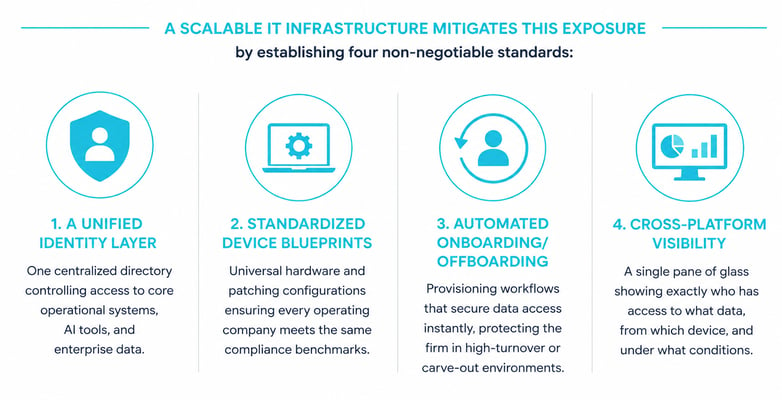
The AI Mandate: Why the Blueprint Can’t Wait
The push to deploy generative AI across the portfolio to drive operating efficiency has made the cost of skipping standardization more immediate, not less.
Rolling out AI tools before a common identity, endpoint, and access standards is in place means sensitive data can move across environments that were never built to share it. Unmanaged devices and inconsistent access controls turn a productivity initiative into a data exfiltration risk. The efficiency gains everyone is chasing get offset by a new category of exposure.
A unified blueprint flips this. It gives leadership one governance mechanism to control data permissions and device compliance before the tools go live, rather than a retrofit to fund later.
Accelerating Time-to-Value on Bolt-Ons
When a platform’s foundation is locked down before the next transaction closes, M&A technology integration moves at a different speed entirely.
Instead of months spent auditing legacy vendors and unwinding inherited access, the platform team onboards the new business to a known standard from day one. The difference compounds with every deal:
|
Without a Unified Standard |
With a Unified Standard |
|
Every bolt-on requires a custom, months-long remediation project, delaying time-to-value. |
New acquisitions convert to standard at close, shrinking integration timelines. |
|
Fragmented tools create blind spots that delay reporting to the board. |
Centralized visibility gives leadership real-time oversight from day one. |
|
Risk compounds with every new connection, quietly discounting the next valuation. |
Pre-vetted controls hold risk flat as the platform grows. |
Building an Audit-Ready, Exit-Ready Platform
Ultimately, the case for a unified IT blueprint is an exit case. It’s the difference between a platform that commands a premium and one that gets discounted for undiagnosed risk.
When buyers, compliance audits, or cyber insurance underwriters review the platform, a single, verifiable record of governance across every operating company signals a mature, cohesive business, not a collection of stitched-together acquisitions still carrying each other’s tech debt. Scalable IT infrastructure helps make that record easier to prove, easier to maintain, and easier to defend during diligence.
Platform Scale Depends on an IT Blueprint
Platform scale doesn’t fail because of one bad IT decision. It fails because, without a unified blueprint, every acquisition inherits the problems of the last one instead of the discipline of a repeatable standard. The blueprint is what turns each new deal from a fresh integration risk into the next proof point of the platform’s operating model — and that compounding discipline is what shows up, eventually, in the exit multiple.